Cruising With My Cat - The Album
Here are nine songs I wrote (or in one case, co-wrote) over many years but never properly recorded and released.
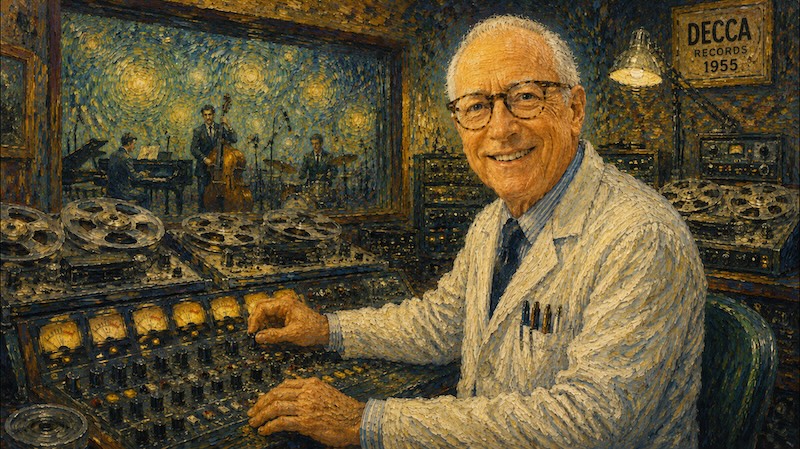
I remember that back in the 1960s I would listen to albums like Sgt Pepper’s Lonely Hearts Club Band, and would imagine how wonderful it must be to go into a recording studio and create that kind of music. Live performance seemed an inferior second that could never capture the complexity and subtlety of a studio recording.
When I started making music seriously, about 25 years ago, my views shifted completely. I found that I love playing live in front of an audience. The slips and imperfections are more than made up for by the buzz of performance and the excitement of taking risks with the music and trying something new on the spur of the moment. You could say I’m an addict.
On the other hand, I’ve discovered that I loathe studio recording. The stress of deciding what the definitive version of a song should sound like, and the need to get it right no matter how many takes make recording, for me, a bit of a slog, and the final result is never quite as good as you think it ought to be.
So, I’m delighted that five of these recordings are of live performances where the last thing on my mind was setting down a definitive rendering for posterity. The other four were originally intended for my own use only, to remind me of what the songs were supposed to sound like if I happened to forget (as has been known to happen).
I hope you enjoy them.
Jonathan H. Klein
The Old Mill (Live)
This song was inspired by the former Abbey Hotel in Romsey, where a folk club run by local folk band Innominata met monthly for years. I used to play floor spots there, and it was here I first played to an audience.
When I wrote the song, in 2004, I was trying to invoke a particular mood in both its sound and its lyrics rather than convey a specific message, but on reflection now, I’d say this was a paean to live music and the venues that support it.
I usually adapt the song to the venue at which I happen to be playing. (When I don’t it goes by the title of The Midnight Hotel.) This live version of the song was recorded at the picturesque Old Mill Hotel in the heart of the New Forest, hence its title here, The Old Mill.
I Ain’t Good for Anything but Love (Live)
Some songs are born when a single phrase pops up in your mind, and you find yourself building a song around it. This is one such song. I wrote it in 2009. I was looking to write something amusing and jazzy. I don’t remember much about its creation other than that it started with the title phrase and that it took a lot longer than I think it should have to write.
Unfortunately, with no strong narrative, and a lot of quick-fire lyrics, I found it challenging to memorise the words, so I didn’t play it live for many years. This recording was, I think, my first major attempt to bring it into my live repertoire. I got the words wrong here and there of course (and I still do), but you get the general idea.
As a self-portrait, this song takes some liberties with the truth. But some of it is accurate. Linda (my wife) frequently laments my inability to slice bread properly. However, I can boil an egg!
If There Were Twenty-Five Hours (Live)
Waiting for a delayed flight in 2009, I had time on my mind and this time the phrase that kicked things off was “if there were twenty-five hours in every day”. I was aiming for something reminiscent of a Cole Porter song, and the way I hear this song in my mind is as big-band swing, sung by someone like Frank Sinatra. On this recording, though, you have to settle for me and my guitar.
When I started writing the song, I’d intended to stick throughout to references to temporal units, but after hours, days, weeks, years and minutes in the first verse I was beginning to run dry and I switched to other weights and measures. I like to think Porter might have appreciated “twenty-one quires in every ream”.
I never expected to be able to play this song live when I wrote it – it seemed to challenge severely my modest instrumental skills. But it turned out to be easier than I thought, and it’s now one of my live repertoire staples.
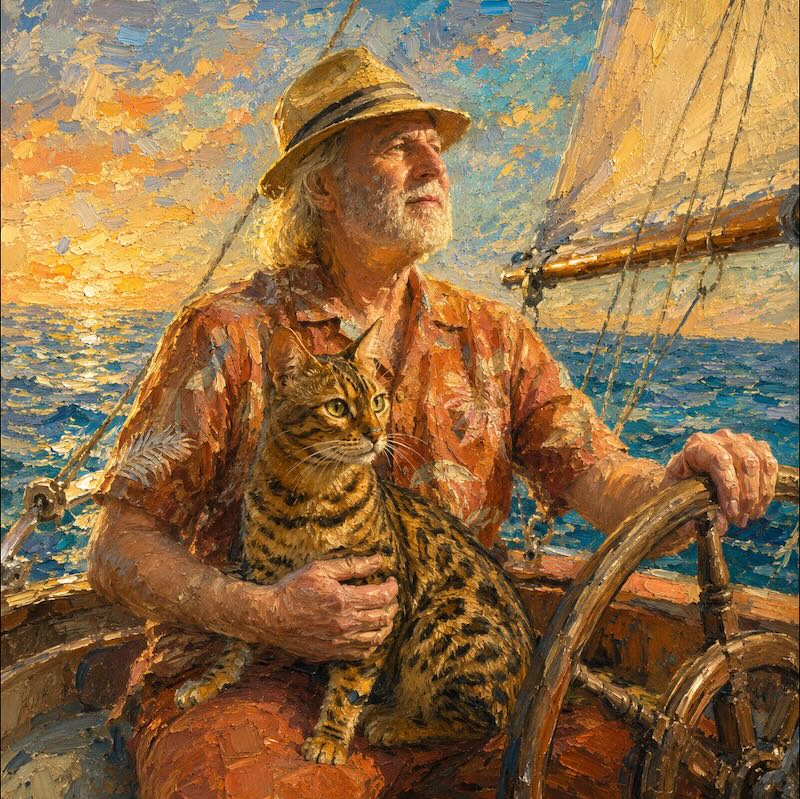
Cruising With My Cat (Live)
Linda and I took a cruise from Southampton to the Canaries over the turn of the year in 2022-23. Linda has an internet account named after Claud, our cat, and from time to time she’d tell me what Claud was up to in the third person.
I happened to comment that it was like there were three of us on the cruise. And thus the seed for the song was sown. As I recall, I wrote most of it in one sitting, during a ‘sea day’ (as we say in the cruising world).
Although sadly no longer with us, Claud lives on in this musical afterlife. His other claim to fame is that he features (anonymously) in a scientific paper about an unusual medical condition, peculiar to his breed (he was a Bengal), which he contracted and from which he then fully recovered.
They Don’t Make Love Like That Anymore (Live)
What most people notice about this song, written in 2025, is the chord progression in the initial bars of each verse (5th to flattened 6th to 6th and back to flattened 6th over a minor chord, since you ask) which is very reminiscent of the underlying chord progression in Monty Norman’s James Bond theme.
The song, though, has nothing to do with James Bond – it’s a whimsical fantasy around the title phrase. It’s a song of imagery rather than any discernible narrative.
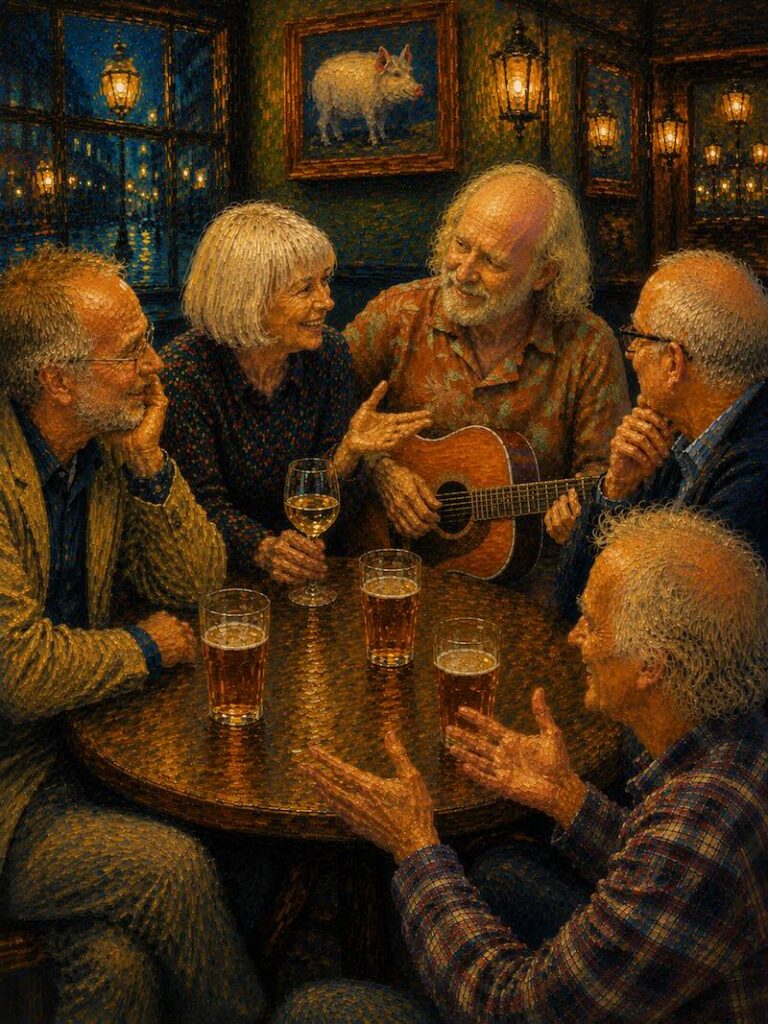
This recording was captured during a ‘Songwriters Singaround’ at The Gun Inn, Keyhaven. Listen out for the unscheduled contribution from Leo the dog, who was otherwise asleep under the table.
Rhyming Dictionary (Restored)
I wrote this song in 2005. Linda had given me a rhyming dictionary for my birthday (I’d asked for one), and this was the first song I wrote using it. You surely didn’t imagine I knew what a teledu was before I wrote the song? More commonly known as the Sunda stink badger, it’s an Asian mammal found in Indonesia and Malaysia, actually more closely related to skunks than badgers.
I’d felt the need for a rhyming dictionary for some time. Is using it cheating? It’s a controversial issue, and, when I looked into it, I found that the debate anticipates current arguments about the use of artificial intelligence in creative work. Anyway, there seems to be good evidence that some of the biggest names in the poetry business made use of rhyming dictionaries when it suited them to do so. So I do too.
These days, of course, you can find rhymes for free on the internet in a matter of seconds. But I still use my print edition.
A Quilter’s Song (Restored)
In 2008 I was asked to participate in an evening of entertainment raising awareness of the National Needlework Archive, on the theme of textiles. The idea was that we would perform a programme of songs and poetry centred on this theme.
We included songs and poetry about sewing, weaving and quilting. Because I’d become intrigued by the cultural role of quilting, I wrote this song.
Historically quilts were often the means whereby individuals or communities recorded narratives or otherwise celebrated aspects of their culture. This song tells of a fictional quilter who records her own tale in the form of the quilt she creates.
Every Time I Touch Down (Restored)
I spend the hours and days before I have to fly in quiet dread. I’m not really a nervous flyer, more a nervous anticipator of flight.
Sitting in an airport (actually the same airport as in If There Were Twenty-Five Hours, but a different delayed flight) with Linda in 2008, the phrase “I hope this plane loves the sky as much as I love you” took shape in my mind.
By the time the flight was over I more or less had the first verses – the final verse, which takes the song in a bit of a different direction, had to wait until I was back home.
No Picnic (Restored)
This song dates from 2010. In an email exchange following a failed funding application with a team of fellow healthcare researchers, I happened to remark that “it wouldn’t be a picnic without the ants”. I’ve no idea where inspired this phrase, but it appealed to my colleague Con Connell, who proceeded to write the poem.
When I first heard him read it at a poetry and music evening a few weeks later, it seemed to be begging to be set to music. So that’s what I did.
Con Connell won the BBC’s Poem for Britain competition in 2003, has co-edited a number of collections of poetry, and was for several years poet-in-residence for Southampton Football Club (Saints). His poems have appeared regularly in The Oldie magazine.The Guardian has found his work “comic, punning”, while The Daily Mail suggests that it “somehow lacks the stirring quality of William Blake”.
Recording Locations
We love recording in historic pubs and the New Forest is full of them!
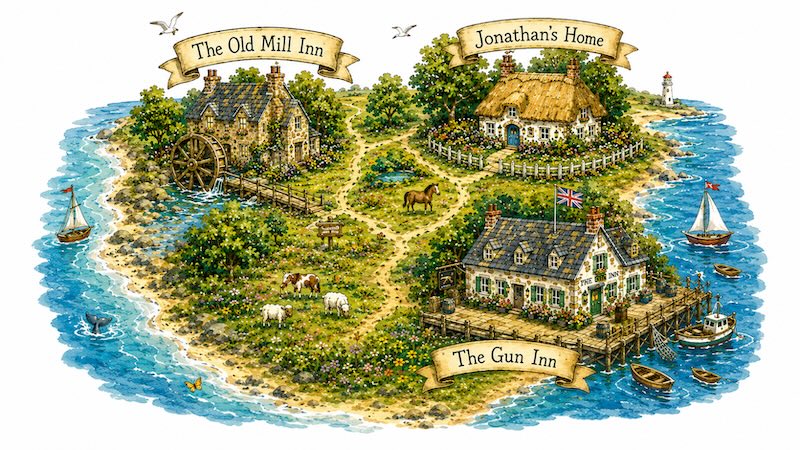
The first four songs were recorded live at a Spring Music Festival at The Old Mill Inn on 14th June 2025. The Old Mill was originally an 18th Century mill in the heart of the New Forest. Despite being an experiment in live sound, the results of the recordings exceeded all expectations.
The fifth song was surreptitiously recorded at a ‘Songwriters Singaround’ held at The Gun Inn, a 17th Century pub in Keyhaven on 11th February 2026.
The final four songs were recorded at home on low-fi equipment at various times in mono, and were not originally intended for release. They have been painstakingly restored and reimagined using modern signal processing techniques.
Acknowledgements
They say it takes a village to raise a child – and it takes a team to record a solo album. I am particularly grateful to:
Linda, my companion and wife, who has suffered my musical endeavours over all these years, encouraged me to first perform in public at that Romsey folk club, and is the unnamed presence in many of the songs in this collection.
Con Connell, work colleague and friend over many years, who wrote the lyrics to No Picnic.
Ian Halliday, who has worked tirelessly to promote local music and musicians in Lymington and beyond for decades, and who organised and managed the Spring Music Festival at the Old Mill near Lymington in the New Forest (14th June 2025) at which four of the songs in this collection were recorded.
Mark Law, who conceived and manages the Local Legends project of which this album is part, and was responsible for the live recordings in this collection, as well as transforming with electronic magic four of my old home recordings into decent renditions.
And then, of course, this album would not be complete without the contributions of Claud (the cat) and Leo (the dog).
Jonathan H. Klein
Production Note
The production of this eccentric and stunningly original album was heavily influenced by wabi sabi, the Japanese aesthetic ideal that finds beauty and serenity in imperfection, impermanence, and simplicity.
The sonic magic resulting from spontaneous live performances and fragile historic recordings on sub-par, improvised equipment could never have been created in the recording studio.
These are world-class transcendent songs.
Mark Law, Recording Engineer & Producer